Identity infrastructure · YC W22
Turning six dashboards back into one platform.
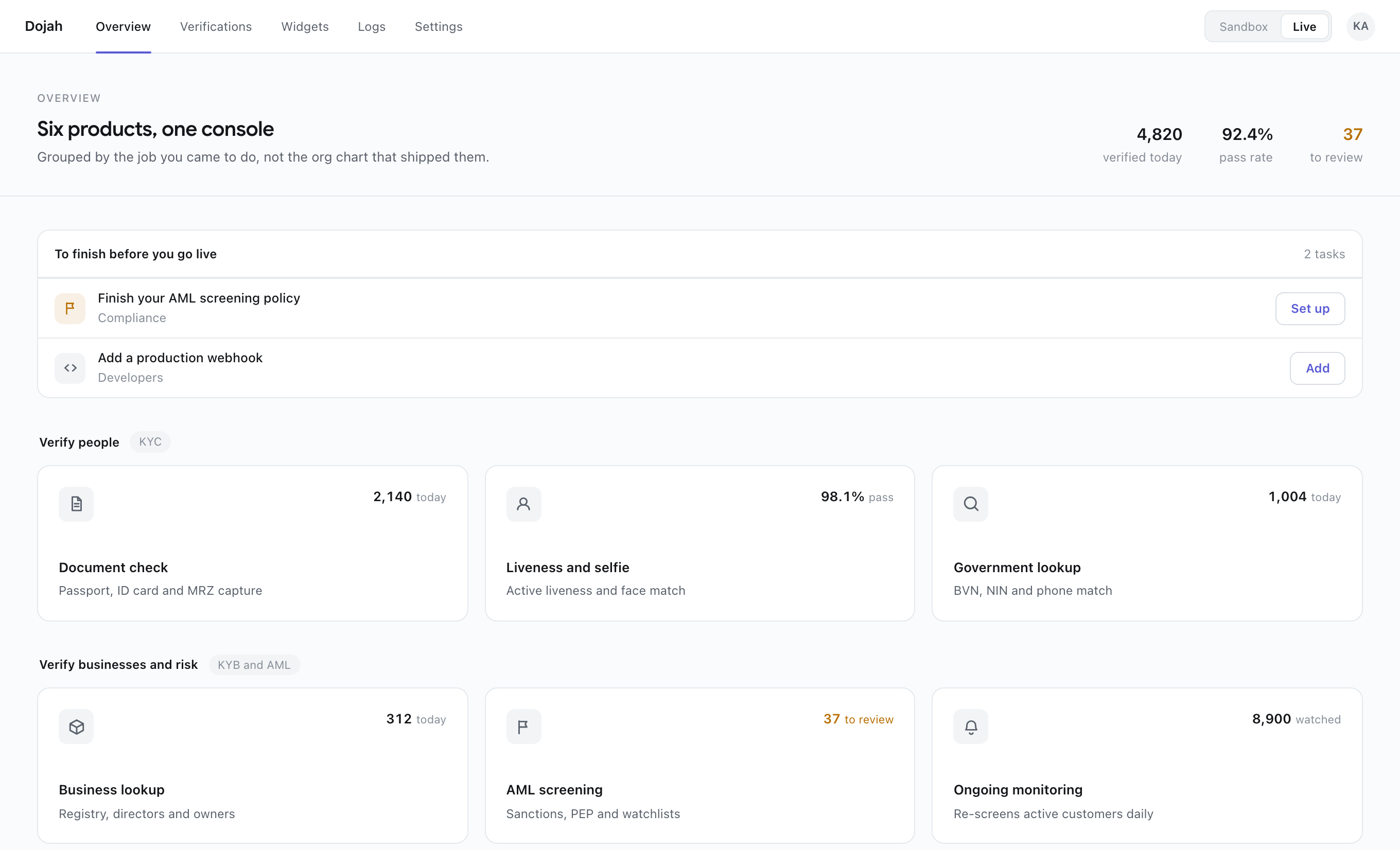
Dojah’s identity APIs worked. The product around them had grown six separate dashboards, and users got lost before their first verification. I found the one problem hiding behind six complaints, and rebuilt the platform on a single information architecture.
- Role
- Product design, IA strategy
- Timeline
- 2021–24
- Product
- Identity verification, YC W22
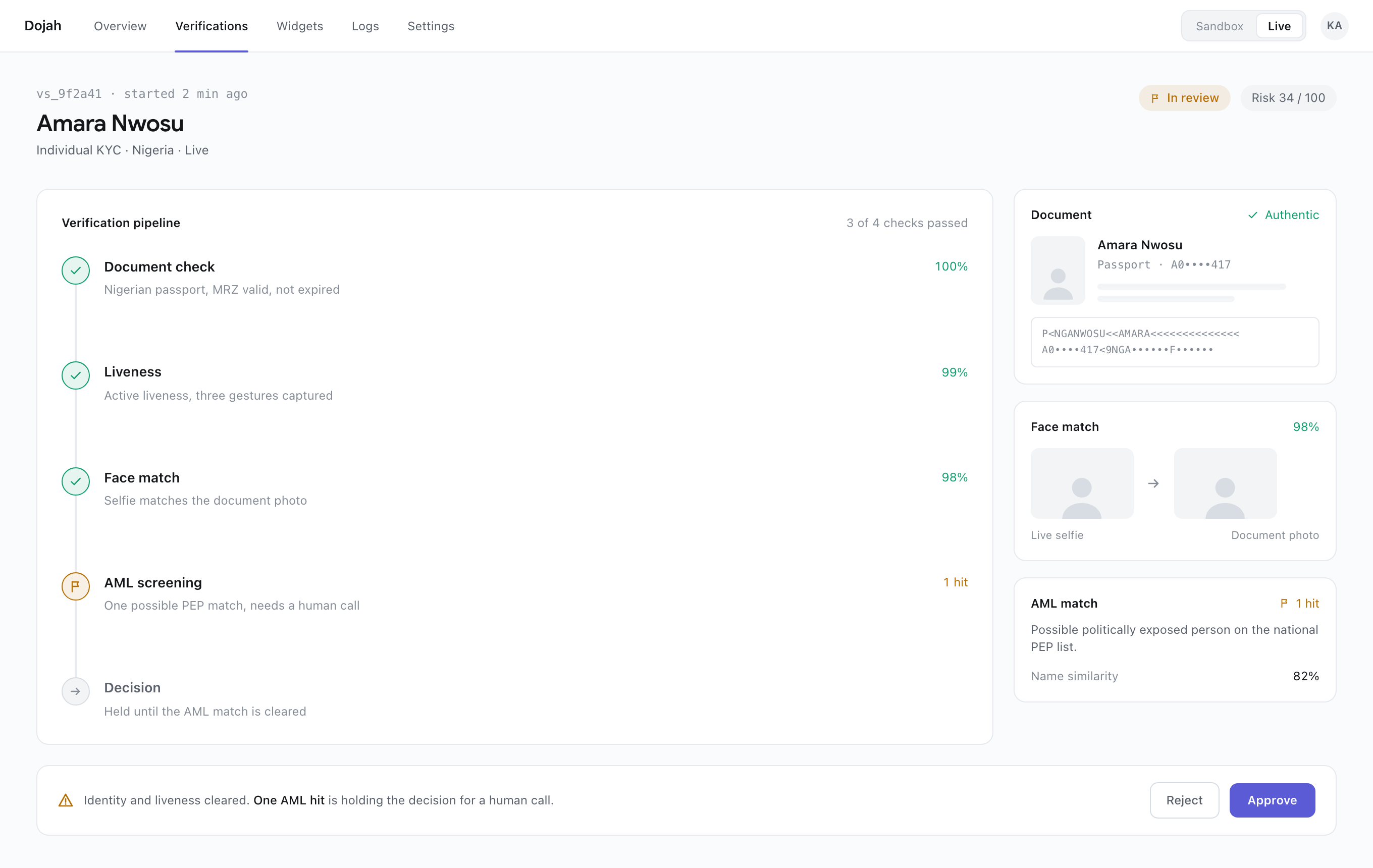
Nigerian passport · MRZ valid, not expired
Active liveness · three gestures captured
Selfie matches the document photo
One possible PEP match on the national list
Held until the AML match is cleared
- −50%
- onboarding time
- −60%
- integration time
- −40%
- customer lookup time
Context
Dojah is Africa’s first end-to-end identity verification platform. I led the redesign of its core web application between 2021 and 2024, working with engineers, PMs, and data scientists to restructure the dashboard, surface compliance, and cut integration time.
The product served two audiences in one screen. Developers came to integrate identity APIs and cared about keys, environments, and docs. Compliance and operations users came to verify customers, run lookups, and manage AML risk, and cared about workflows, not endpoints. The dashboard treated both the same, and both struggled.
The challenge
Every product had grown its own surface. KYC, KYB, AML, document checks, widgets, and lookups each had a place, but none of them shared a shell. New users landed and could not tell where their job began.
Developers could not find their API keys. Operations users skipped critical compliance tasks because they were buried under product screens. Everyone confused Sandbox and Live, hit the wrong endpoint, then opened a support ticket.
In the support queue
I read the tickets and expected six problems. Where are my keys. Why did my call fail. Where is the compliance step. Am I in Sandbox or Live. How do I look up a customer. Why is this task blocking my launch.
They were not six problems. They were one problem asked six ways.
The reframe
It was never six problems. It was one architecture problem.
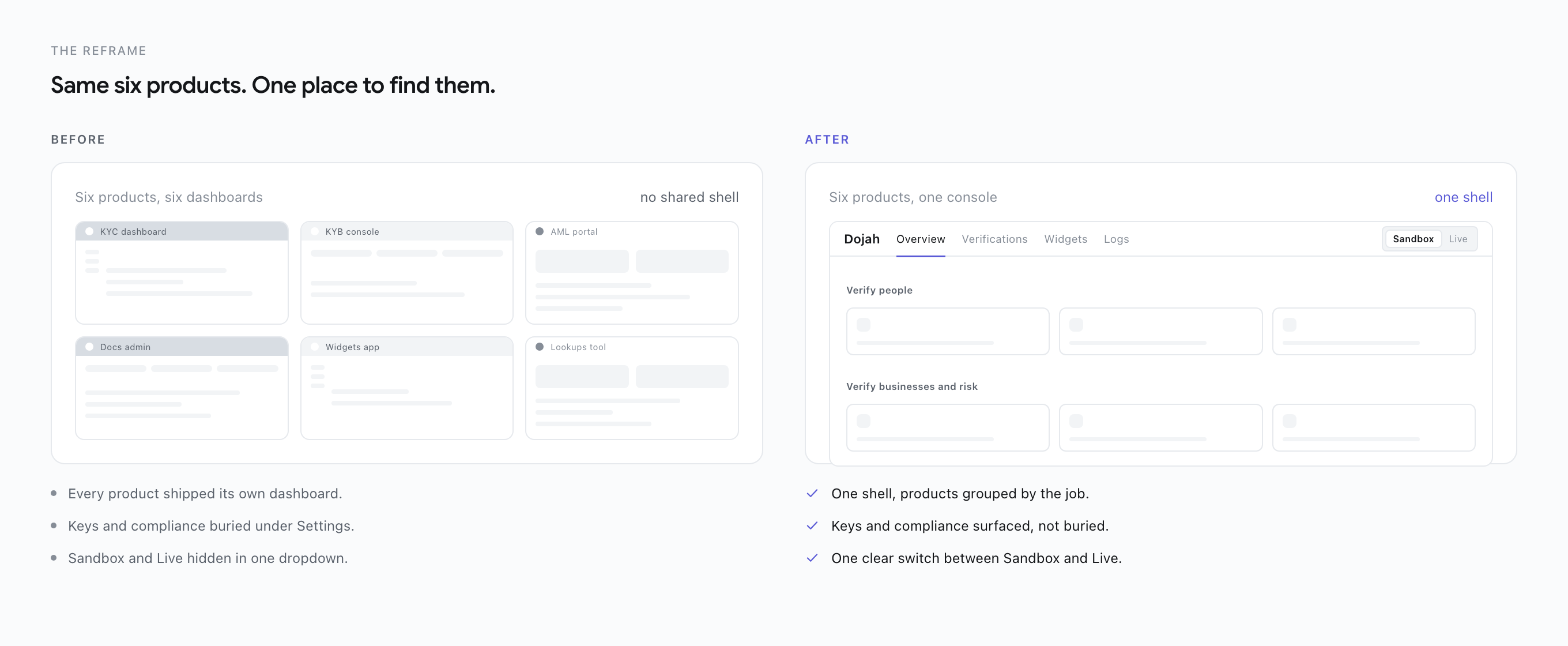
The information architecture was built for the org chart, not the job. Engineering features lived under Apps. Compliance lived under Settings. Sandbox and Live were a single dropdown most users never saw. Once I saw the IA as the root cause, every fix lined up against the same north star: every feature should live where the job actually starts.
The rebuild
Three moves, each aimed at one way the old architecture got in the way.
Move 01
From the org chart to the job
The old dashboard was grouped the way the platform was built. Engineering features sat under Apps, compliance sat under Settings, and Sandbox and Live were one dropdown most people never noticed. I regrouped every surface around the job a person came to do, so keys, verifications, and AML each live where the work starts. A Quick Actions list surfaces the compliance and go-live tasks that used to get skipped. A few advanced features moved one click deeper. In return, the tickets asking where is X went quiet.
Move 02
From a verification you could not follow to one you can
On the operations side, a single check was a black box. I rebuilt it as a pipeline: document, liveness, face match, AML screen, decision. Each step carries its own status, so a reviewer sees exactly where a case sits and what is holding it. Clean identity and liveness no longer wait behind an AML hit. The one thing that needs a human is the only thing a human has to touch.
Move 03
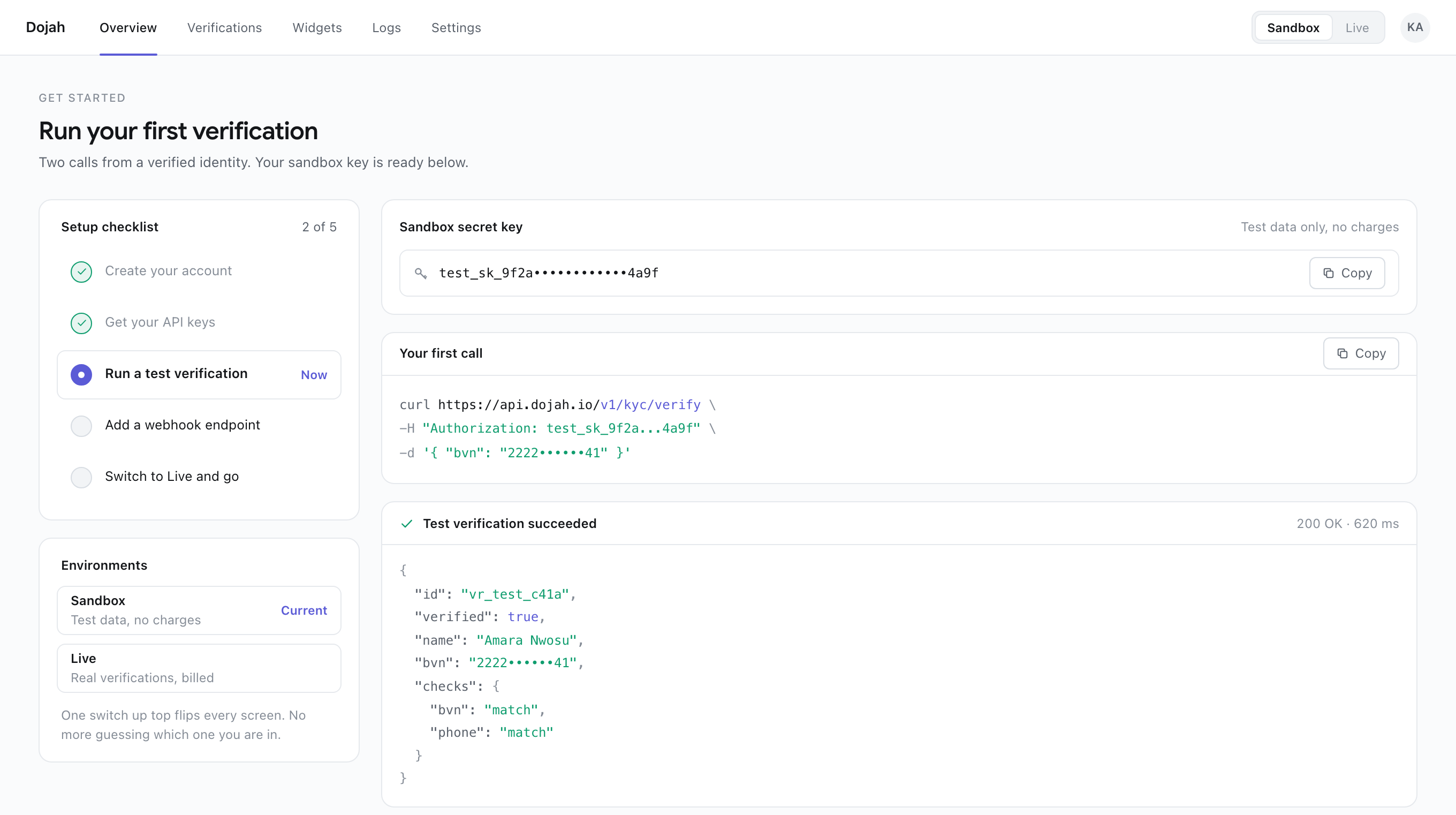
From a cold start to a first verification in minutes
Developers used to hunt for their keys and guess which environment they were in. The new get-started surfaces the sandbox key, a copyable first call, and one persistent switch between Sandbox and Live. Integration time fell by more than half. The Sandbox and Live mix-up, once the single highest-volume support ticket, nearly disappeared.
What changed
Onboarding and compliance time dropped by more than half. Developer integration time fell 60%. Easy Lookup, a six-step flow I cut to two, took 40% off the most-used task on the dashboard. Support tickets across the IA and API-visibility categories dropped sharply.
“Nobody files a ticket about information architecture. They file six tickets that all have the same cause.”
Adoption was smooth because the change was legible: a one-time welcome screen highlighted the new layout, paired with a targeted email from marketing.
Reflection
Dojah taught me that navigation is a polite word for a broken information architecture. Users do not complain about IA. They complain about features being hard to find, tasks being skipped, environments being confused. Six different complaints, one root cause.
The hardest part was not the design. It was convincing engineering and product leadership that a redesign of the menu was a redesign of the product’s mental model, and worth four months of focus.