Designing the discovery layer for Nollywood's YouTube era
FilmFlux
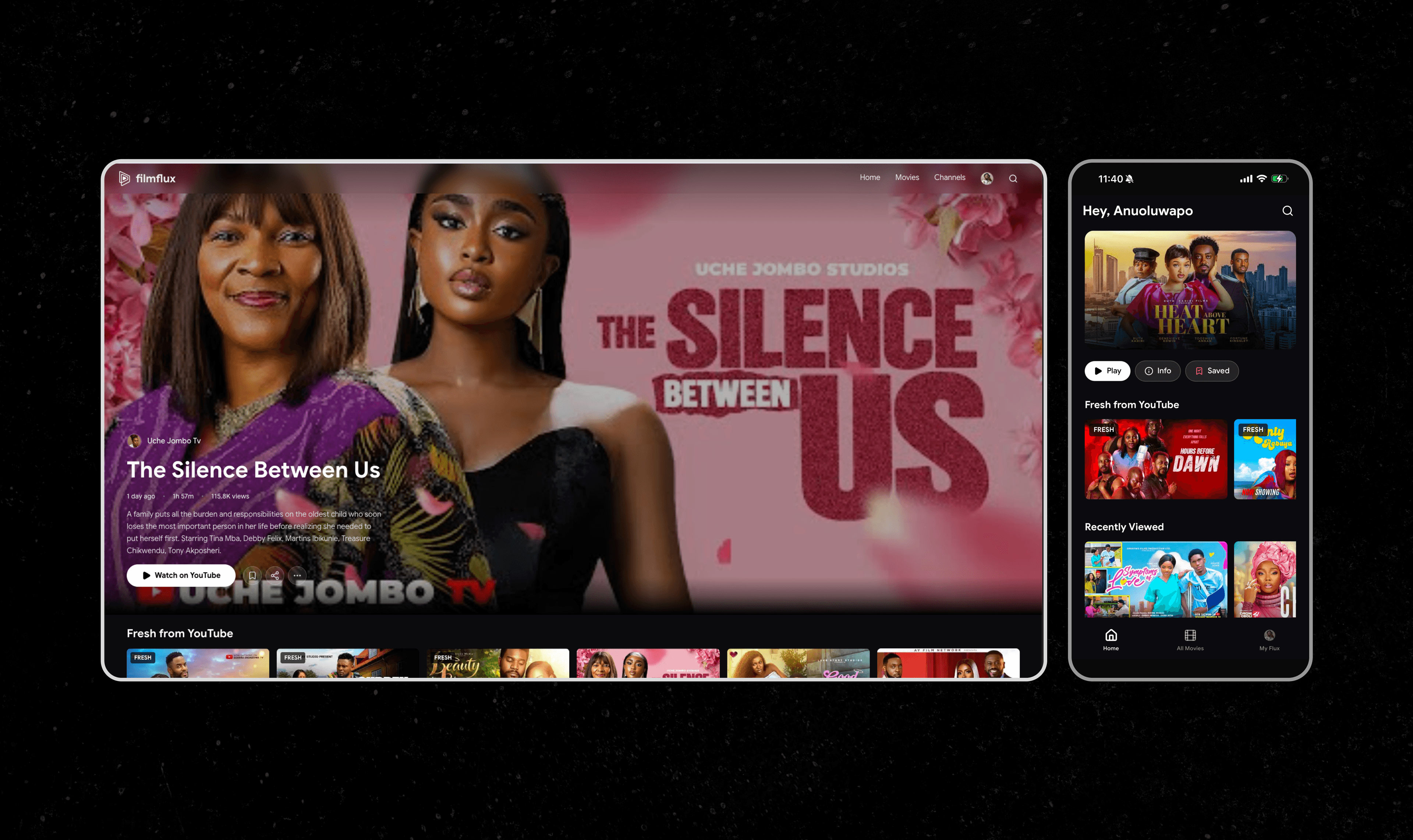
In early 2026, something fundamental shifted in Nollywood.
Producers who once relied on cinema runs, licensing deals, and global streamers began releasing directly on YouTube. Not as a fallback. Not as an experiment. As a strategy.
Actors and filmmakers like Deyemi Okanlawon spoke openly about the freedom it offered. Veterans such as Kanayo O. Kanayo described it as an escape from exploitative intermediaries. Creators including Omoni Oboli began clocking millions of views within days of release.
Distribution had changed.
Discovery had not.
That gap became FilmFlux.
The Problem
YouTube is built for algorithms, not film libraries.
As more Nollywood producers launched dedicated channels, several new problems emerged:
High quality films were buried within hours
Older titles disappeared beneath the algorithm cycle
Viewers struggled to keep up unless they followed specific channels
Browsing meant endless scrolling
For fans, it was overwhelming.
For creators, it meant visibility depended on timing and luck.
Nollywood had solved distribution. It had not solved navigation.
Reframing the Opportunity
Instead of competing with YouTube, I asked a different question:
What if YouTube is the infrastructure, and FilmFlux becomes the discovery layer?
Not a streaming service.
Not a licensing platform.
Not another gatekeeper.
A curated interface that surfaces what already exists and sends traffic directly back to creators.
That constraint shaped every product decision that followed.
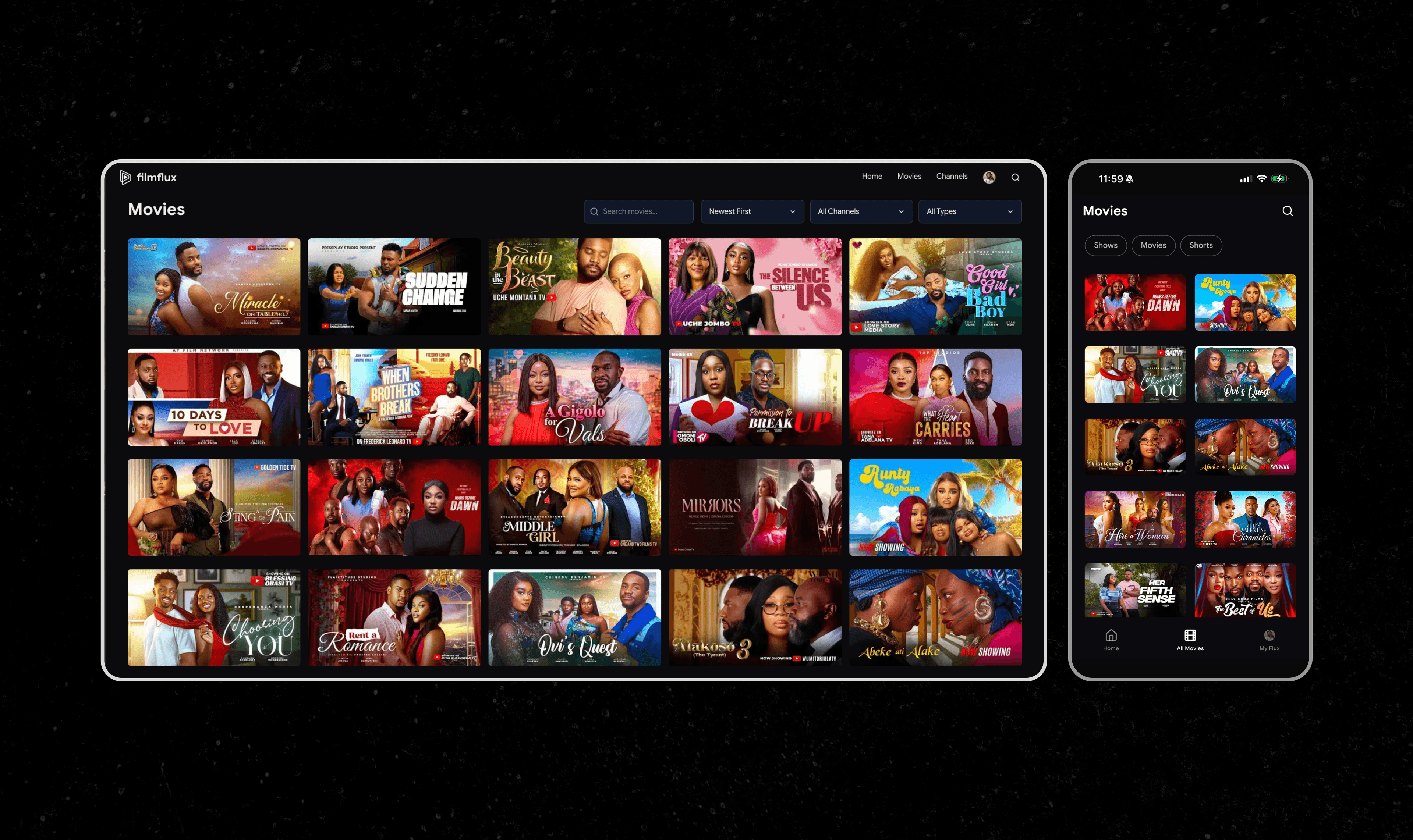
Building FilmFlux
From idea to multi-platform product in 7 weeks
Between August 2025 and February 2026, I designed and built FilmFlux end to end.
The goal was clarity and speed, not feature bloat.
Core principles
- Never host content
- Never take revenue from creators
- Reduce friction between viewer and film
- Make browsing feel intentional, not algorithmic
Core Principles
The goal was clarity and speed, not feature bloat. Every decision was guided by four fundamental principles that shaped the product's direction and implementation.
Never host content - We route traffic back to creators
Never take revenue - Creators keep 100% of their earnings
Reduce friction - Make discovery effortless
Intentional browsing - Replace algorithmic chaos
The System
FilmFlux aggregates films from 96 verified Nollywood creator channels and presents them in a Netflix style interface.
Today the platform includes:
- 1,889 indexed movies
- Semantic search powered by AI embeddings
- Cross device watchlists
- Push notifications for new releases
- Web, PWA, iOS, and Android deployments
The stack:
- Next.js 15
- React 19
- Supabase with PostgreSQL
- OpenAI embeddings
- YouTube Data API
Underneath the surface, the system includes 40+ backend functions, 218 database migrations, and automated ingestion pipelines that keep content fresh without manual curation.
But the technology only mattered if it solved the discovery problem.
Designing for Discovery
Semantic Search
Keyword search failed immediately. Users do not search for exact titles. They search for intent:
"cheating husband movie"
"Yoruba romantic comedy"
"Bimbo Ademoye drama"
I implemented hybrid semantic plus keyword search using vector embeddings. Instead of matching words, the system matches meaning.
The result was a 300 percent improvement in discovery success for natural language queries.
Search began to feel conversational.
Curation Over Chaos
YouTube's homepage optimizes for engagement velocity. FilmFlux optimizes for clarity.
Instead of infinite scroll, the interface uses structured rows:
New Releases
Trending This Week
Editor Picks
Channel Spotlights
Each row is intentional. No random surfacing. No algorithm surprises.
This design choice replaced noise with direction.
Platform-Aware Experience
FilmFlux runs on web, PWA, iOS, and Android from a single codebase.
But parity was never the goal.
Web prioritizes SEO and sharing
PWA prioritizes instant navigation
iOS uses native authentication flows
Android uses Trusted Web Activity for seamless updates
Each platform respects its environment rather than forcing sameness.
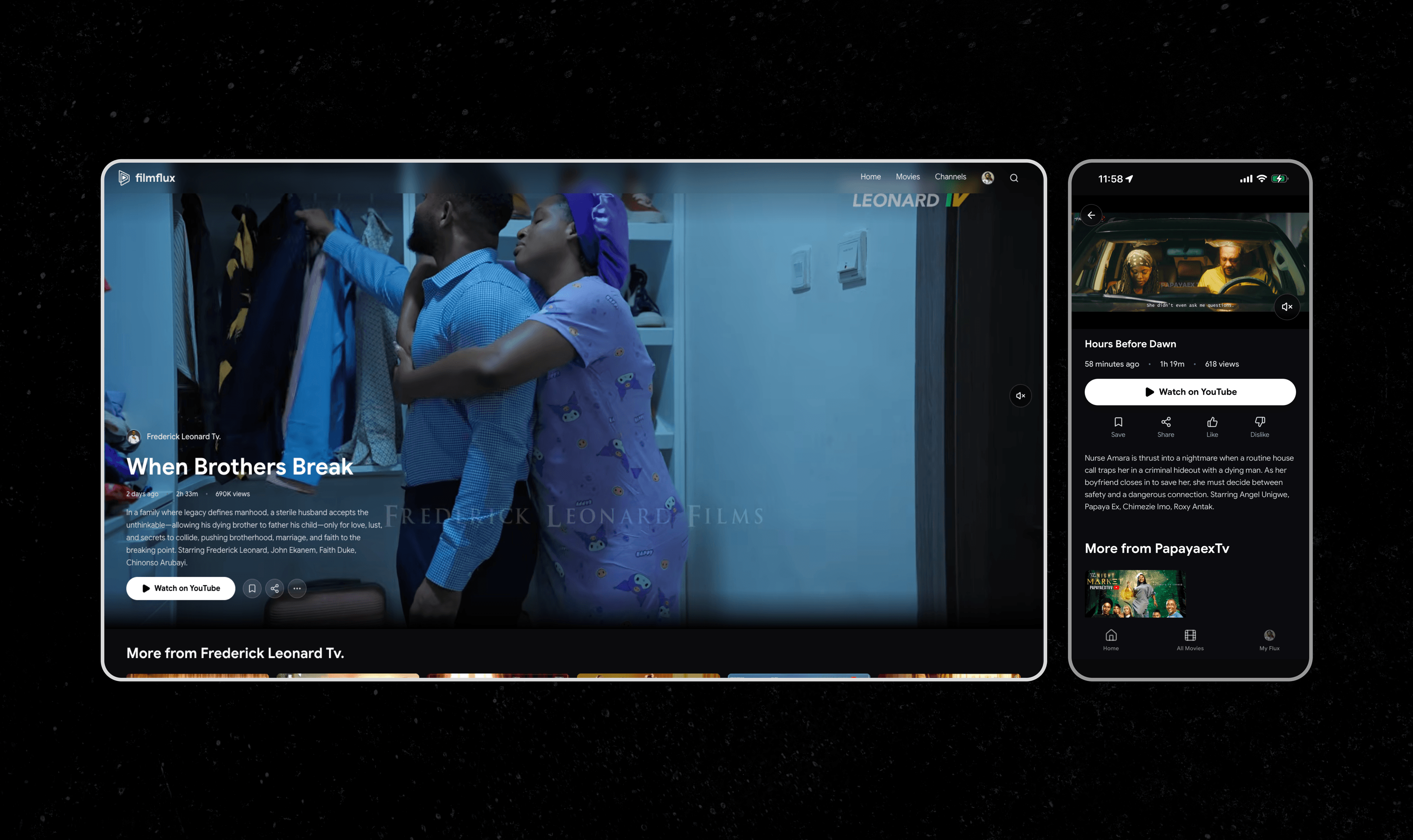
The Hidden Work
Security, performance, and scale
Because FilmFlux routes traffic to creators, trust is essential.
- Row Level Security protects database integrity
- Rate limiting prevents abuse
- JWT authentication secures APIs
- Edge caching keeps navigation instant
Local caching ensures the app feels immediate. Background refresh keeps content current.
The experience is simple. The system beneath it is not.
Early Impact
In its first phase, FilmFlux:
- Indexed nearly 2,000 films
- Tracked over 4,000 users
- Achieved strong push notification engagement
- Drove traffic back to verified creator channels
Most importantly, it proved something:
Discovery can scale alongside distribution.
The product still keeps getting iterated based on feedback, continuously improving the discovery experience for Nollywood audiences.
What This Means for Nollywood
Nollywood has entered a creator-led era.
With YouTube as infrastructure, producers control:
- Release timing
- Monetization
- Audience engagement
- Ownership
The next challenge is sustainability.
As more creators launch channels and production output accelerates, discoverability becomes the bottleneck.
FilmFlux exists to remove that bottleneck.
Reflection
This project was not just a technical build. It was a response to an industry shift.
Instead of asking how to compete with YouTube, I asked how to make it more usable for African cinema.
The result is a lightweight, scalable discovery layer that strengthens creators rather than replacing them.
YouTube may be the present infrastructure of Nollywood.
FilmFlux is designed to make that infrastructure navigable.
And as hybrid models emerge, combining cinema releases, direct publishing, and global collaborations, discovery will only matter more.
The revolution is not just about where films are released.
It is about whether audiences can find them.