AI partner development · GTM
An AI partner manager that learns from who you pay.
Souk finds partners, runs their deals, and pays their commissions. I designed the loop that closes it. Every payout teaches the product which kind of partner to source next.
- Role
- Product design, end to end
- Timeline
- 2025–26
- In production at
- Deel, Vanta, Google
- 5→1
- tools replaced
- 100%
- deals attributed to a partner
- 0
- payout spreadsheets
- 1
- loop that learns
Context
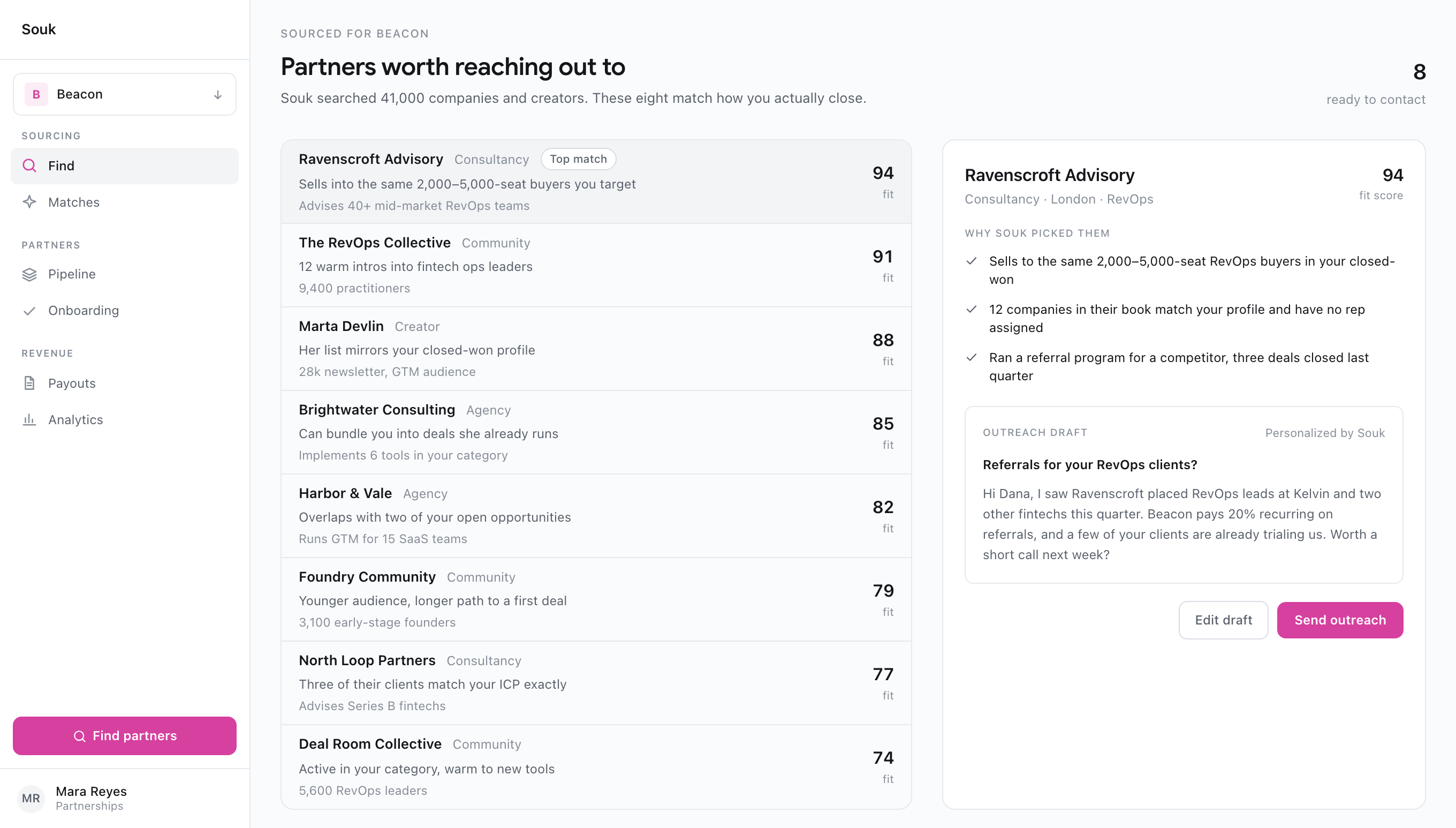
Souk is an AI partner development manager. It runs the whole partner lifecycle for GTM and RevOps teams: sourcing the right partners, tracking the deals they bring, and paying their commissions. It is in production at Deel, Vanta, and Google. I was the product designer, and I owned the three surfaces that make up the loop: Find, Pipeline, and Payouts.
The challenge
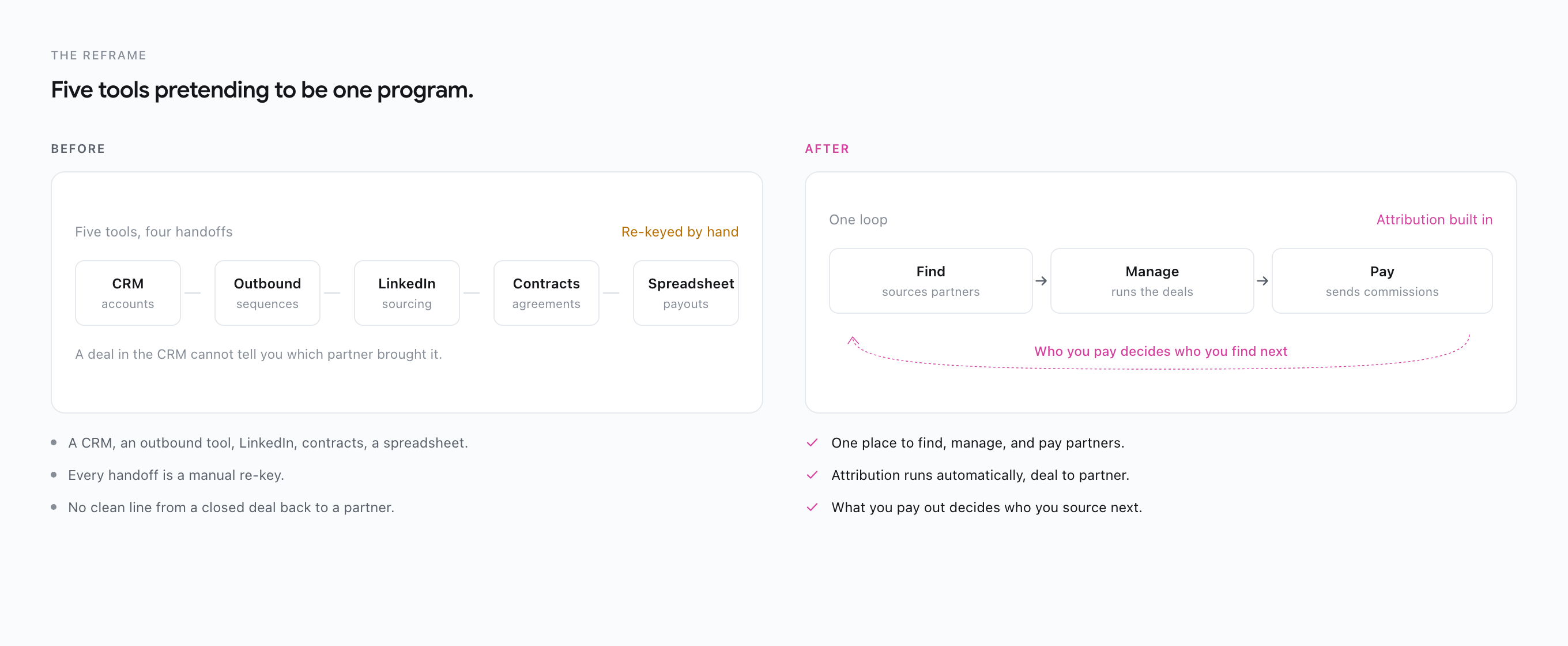
A partner program is one job that companies run across five tools. A CRM for accounts, an outbound tool for sequences, LinkedIn for sourcing, a contract app for agreements, and a spreadsheet for who gets paid.
Every handoff between them is a manual re-key, and nothing ties the pieces together. A deal closes in the CRM and no one can say for certain which partner brought it. Payouts get calculated by hand from a spreadsheet that is always slightly wrong. The whole program leaks at the seams.
In the field
I sat with partner managers and watched the day go. Most of it was admin. Copying a name from LinkedIn into the CRM. Chasing a contract. Reconciling a payout spreadsheet against deals that may or may not have been attributed right. The one question that actually mattered, which partners are worth more of my time, was the one thing none of the tools could answer, because the money they paid out never talked to the partners they went looking for.
The reframe
Stop building five tools. Build one loop where the money you pay out teaches you who to find next.
The design job was not five better tools. It was one loop with no seams. Find sources a partner, Manage runs the deals with attribution built in, Pay sends the commission from the revenue that partner closed. And then the loop closes: the payout data tells Find which partner types actually produce, so the next search is smarter than the last. One system that gets better every time it pays someone.
How the loop holds
Find is only the opening. Two moves make the rest hold together: attribution that never leaks, and a payout that teaches the next search.
Move 01
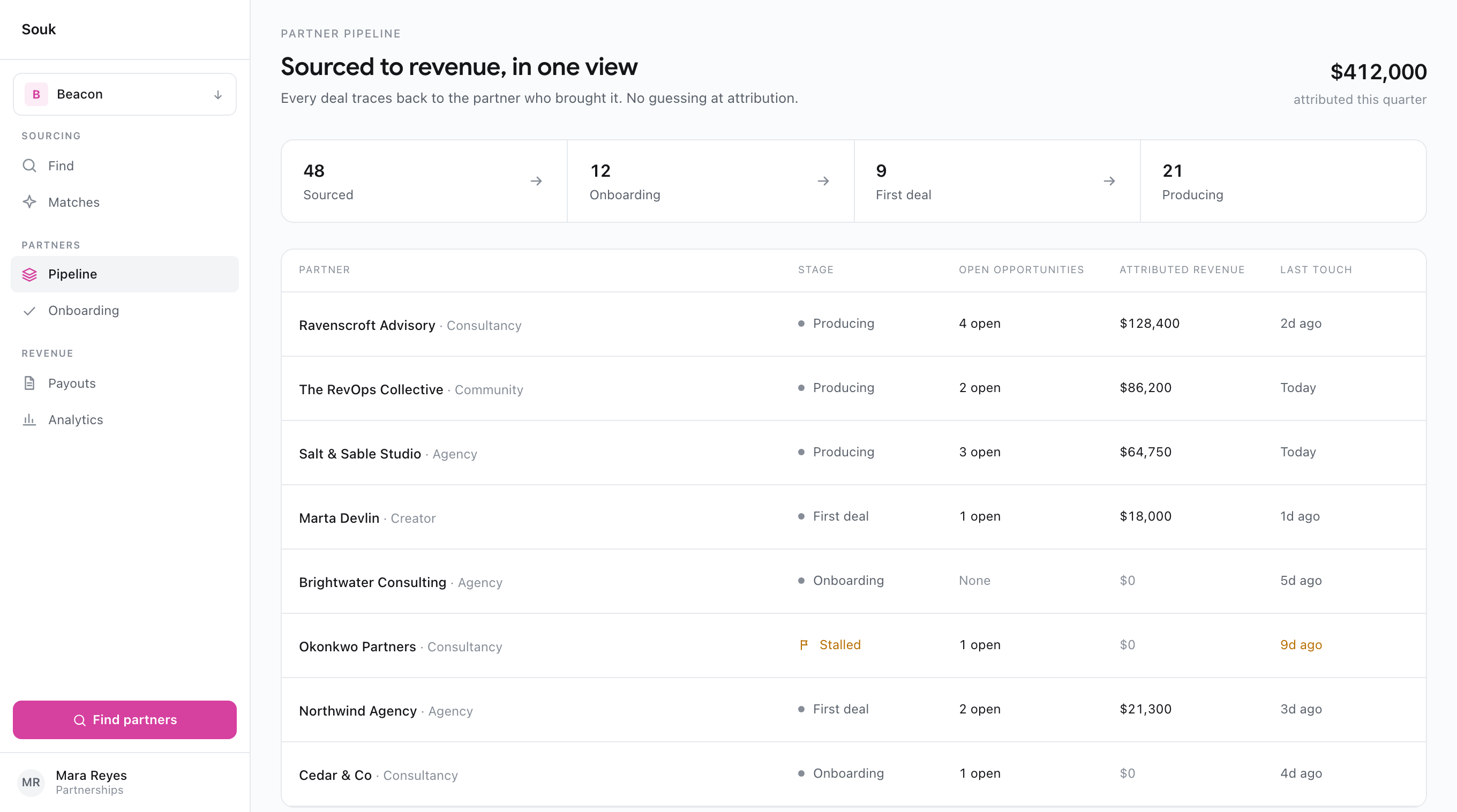
From a leaky CRM to attribution that holds
Sourcing is only useful if the deals that follow trace back to the right partner. I built the pipeline around attribution: sourced, onboarding, first deal, producing, with the revenue owned by the partner who brought it. Nothing gets re-keyed between stages. The partner going cold surfaces on its own, so a manager works the row that needs them instead of scanning the whole list.
Move 02
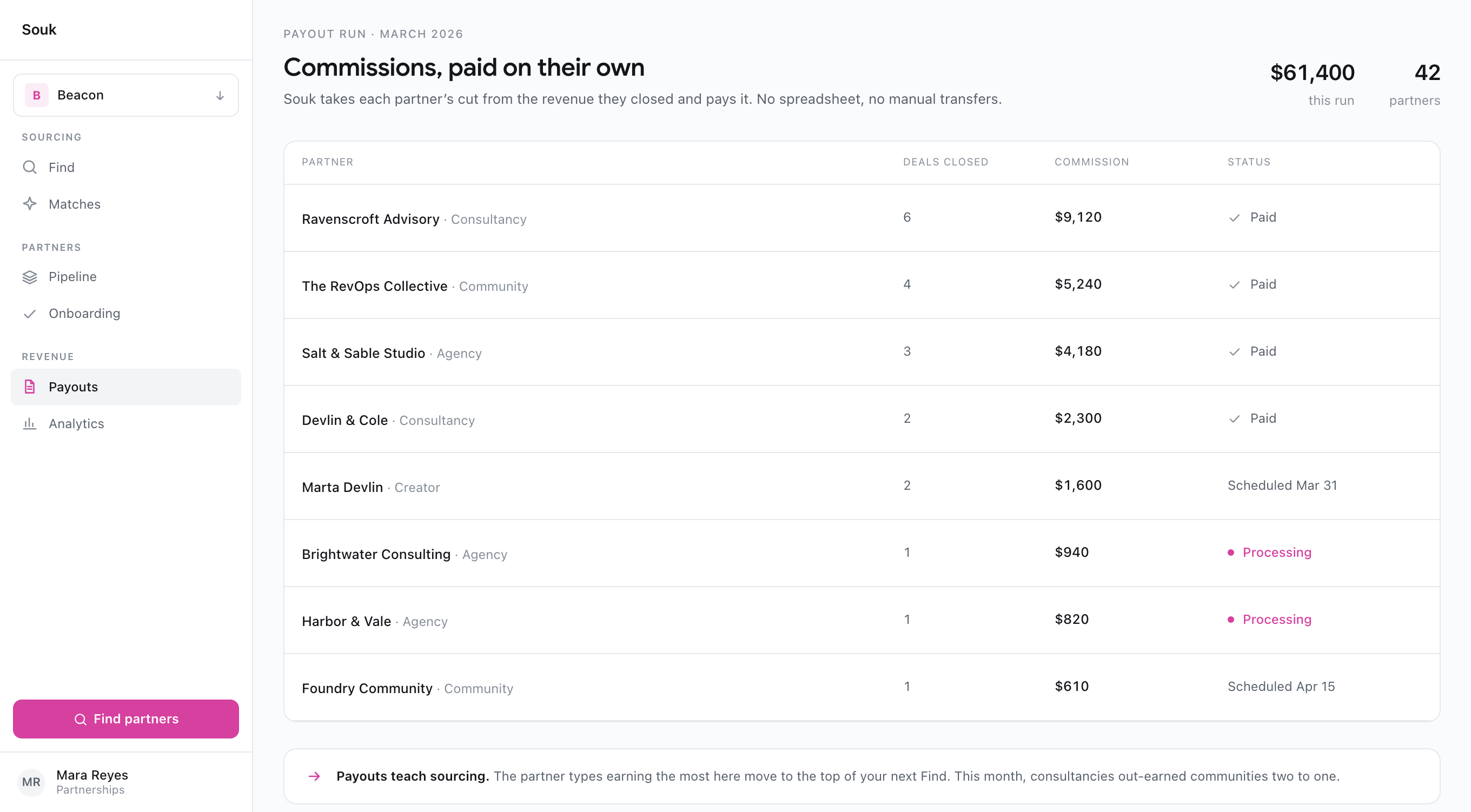
From a payout spreadsheet to a loop that learns
The last step is where most tools stop: pay the partners. Souk takes each cut from attributed revenue and pays it automatically. Then it does the thing a spreadsheet never could. It reads who earned the most and feeds that back into sourcing, so the next Find leans toward the partner types that actually produce. Paying a partner is also how the product gets smarter.
What changed
The loop replaced the stack. Partner teams at Deel, Vanta, and Google run sourcing, deals, and payouts in one place instead of five, and the manual re-keying between them is gone.
“A partner program was never five tools. It was one loop that no tool had bothered to close.”
Attribution is the part that made it hold. Because every deal is owned by the partner who brought it, payouts are exact instead of a monthly reconciliation, and the same data feeds sourcing. The product learns which partner types pay off and finds more of them. It gets better the longer a team uses it.
Reflection
Souk taught me that the product is the loop, not the screens. Anyone can design a sourcing tool, a pipeline, and a payout table. The design work was making the last step feed the first, so paying a partner is also how the product learns who to find next.
I refused to ship three good tools when the job was one loop that closes on itself.